
AI Is Set to Transform Mobile App Design for Fintech
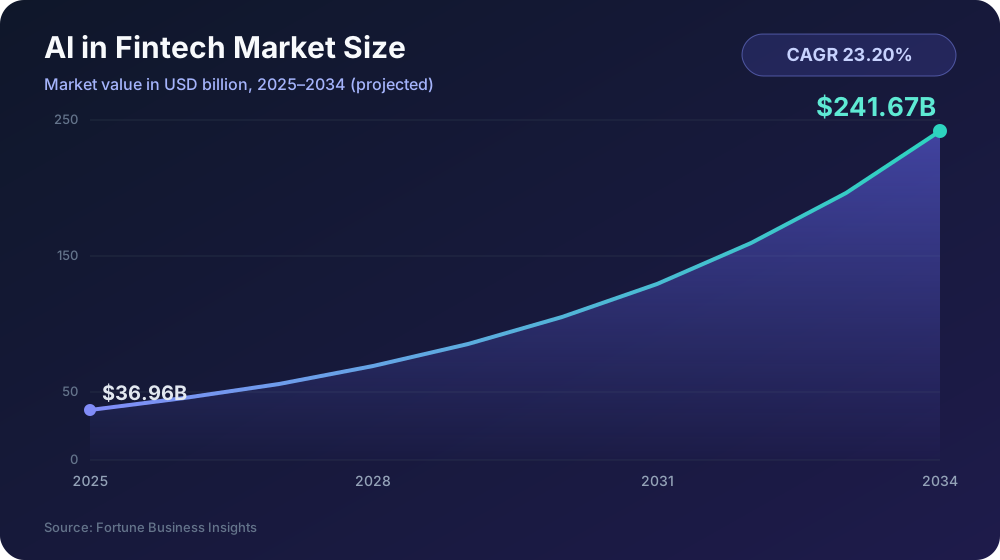
AI is set to transform mobile app design for fintech — not as a cosmetic upgrade, but as a fundamental shift in how users discover, understand, and act on financial information. The global AI in Fintech market was valued at $36.96 billion in 2025 and is projected to reach $241.67 billion by 2034, growing at a CAGR of 23.20% (Fortune Business Insights). As adoption accelerates, fintech companies must enhance their products with AI to improve ease of use without compromising security, compliance, or trust. Here is a detailed analysis of how the field may evolve and how the industry must adapt to rising user expectations.
Analysis by Thiyagaraaj M — a practitioner’s view on system design, digital solutions, and applied AI.
Executive Summary
For fintech leadership and top management: the next competitive edge is not a better AI model — it is a better mobile experience. Users are abandoning dashboard-heavy banking apps in favour of intent-driven, mobile-first flows. Organizations that redesign around hybrid UX (conversational entry + structured execution), on-device AI, and proactive intelligence will capture market share. Those that bolt chatbots onto legacy interfaces will not.
The AI-in-fintech market reaches $241.67B by 2034, and the AI mobile app market grows by 35%+ annually. Security, compliance, and explainability are non-negotiable. The full analysis follows below.
How User Behavior Has Shifted
Users no longer accept the design patterns they tolerated a few years ago. Apps that cling to outdated workflows risk losing market share — as native banking apps have in India, where UPI accounted for approximately 83% of retail digital payment volume in FY25 (Business Standard / RBI data). The majority of routine retail payments now flow through UPI apps such as PhonePe, Paytm, and Google Pay. Users turn to native banking apps primarily when UPI cannot handle a task — such as larger transfers, loan management, investments, or account servicing.
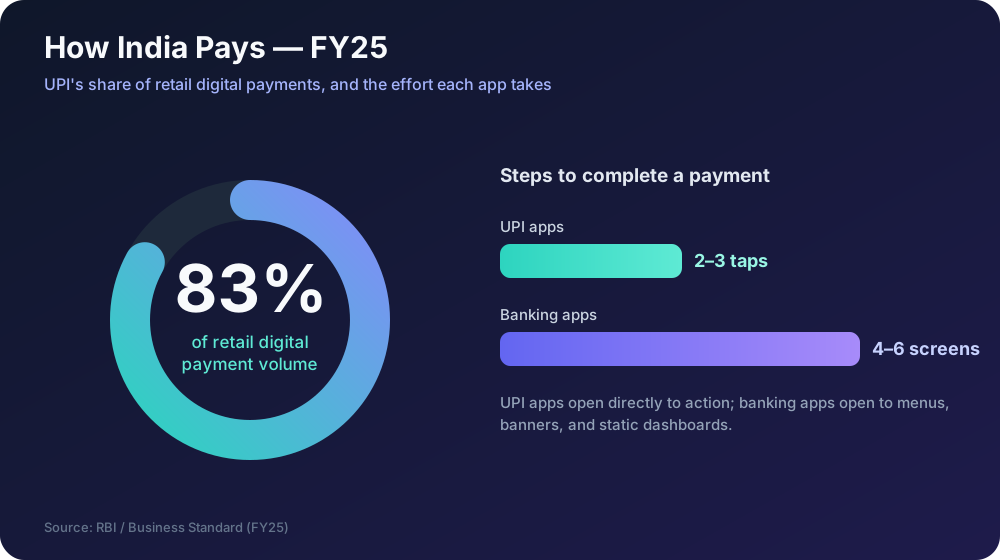
The contrast is instructive. UPI apps open directly to action: scan, pay, send. Banking apps open to menus, banners, and static dashboards. Users have shifted from menu-driven navigation to intent-driven interaction — they state what they want and expect an immediate answer.
What Users Expect From Fintech Apps in 2026
Three principles now define modern fintech UX.
1. Lightweight, intent-first flows
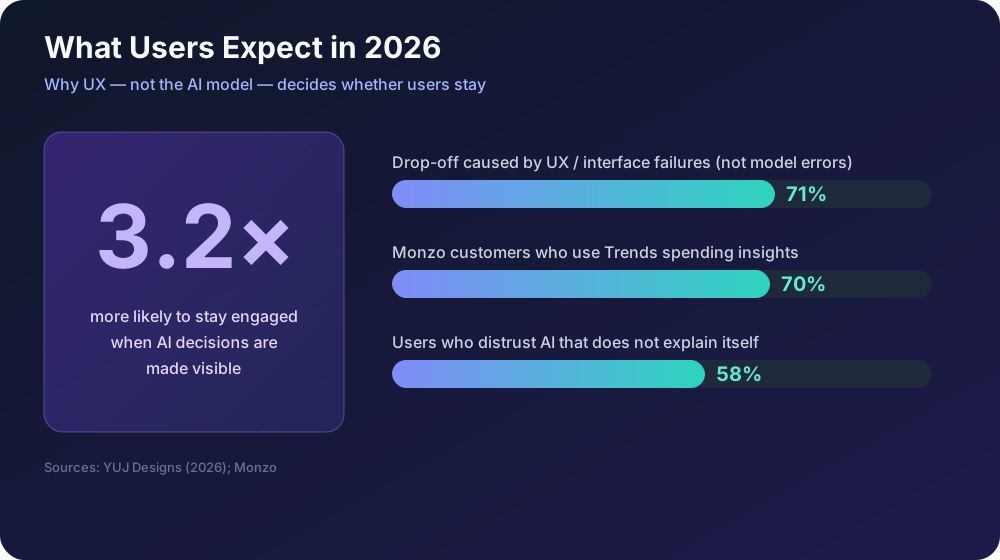
Users prefer short, direct processes over multi-screen journeys. Early industry research from YUJ Designs (2026) found users are 3.2× more likely to stay engaged when AI decisions are made visible, and 58% distrust AI products that do not explain their recommendations.
2. Proactive intelligence, not passive dashboards
Action-oriented dashboards that surface insights and next steps still work — Monzo’s Trends feature, used by 70% of its customers, is proof. Static, link-farm home screens do not. Users expect apps to act on their behalf:
- You are subscribed to these services, but there are free alternatives you can try.
- This month’s food-order spending has exceeded $1,000, which is higher than your usual pattern.
- Your internet bill payment failed and requires manual action.
According to industry reports, banks that surface proactive spending insights and payment-failure alerts see higher engagement than those relying on static dashboards alone.
3. Trust through transparency
Financial apps are becoming less like closed-box systems. Explainable AI, plain-language disclosures, and visible decision logic are no longer optional — they are baseline expectations.
Rethinking Fintech App Design
Conversational entry, structured execution
Banking apps need a heavy shift toward immediate results. Instead of making users navigate extensive menus, apps should offer a simple entry point — text or voice — where users state their intent:
- “Show my balance.”
- “Show my last five shopping transactions.”
The interface should present only the information relevant to that query. But the goal is not to replace all UI with chat. High-risk actions — wire transfers, loan approvals, KYC verification — still require structured confirmation flows, clear audit trails, and explicit user consent. The future model is hybrid: chat for intent, structured UI for execution.
Conversational entry should support multiple input modes — text, voice, and direct tap actions — so the experience stays fast and inclusive without reverting to cluttered dashboards.
Indian banks such as HDFC Bank (EVA) and ICICI Bank (iPal) already layer conversational assistants over traditional banking UI — demonstrating the hybrid pattern in practice, though none have gone fully chat-first.
Beyond banking: lending and onboarding
Loan apps and small-finance apps face the same friction. Collecting name, phone, email, PAN, photo, and address across 3–5 screens creates drop-off even when the actual process is short. Chat-based product clarity — upfront details on returns, fees, pre-closure conditions, and repayment options — reduces abandonment. Jupiter in India and Monzo globally show that automated savings, spending categorization, and reward-driven engagement outperform form-heavy onboarding.
What UPI got right (and banking apps still get wrong)
| UPI apps | Traditional banking apps |
|---|---|
| Open directly to action | Open to menus and banners |
| Complete a payment in 2–3 taps | Navigate 4–6 screens for basic tasks |
| Proactive transaction notifications | Passive balance displays |
| Minimal information per screen | Information overload on the home screen |
AI Agents: Expectations and Implementation
Users are becoming more willing to allow AI agents to analyze their financial data and provide suggestions about financial impact — as seen in the proactive-alert scenarios above.
Users love to use AI. Interestingly, 71% of user drop-off in AI-powered applications is caused by UX and interface failures, not by the AI model returning inaccurate data (YUJ Designs, 2026). The demand is real — but design execution determines whether users stay or leave. This growing willingness to share financial data with AI agents also comes with significant risks.
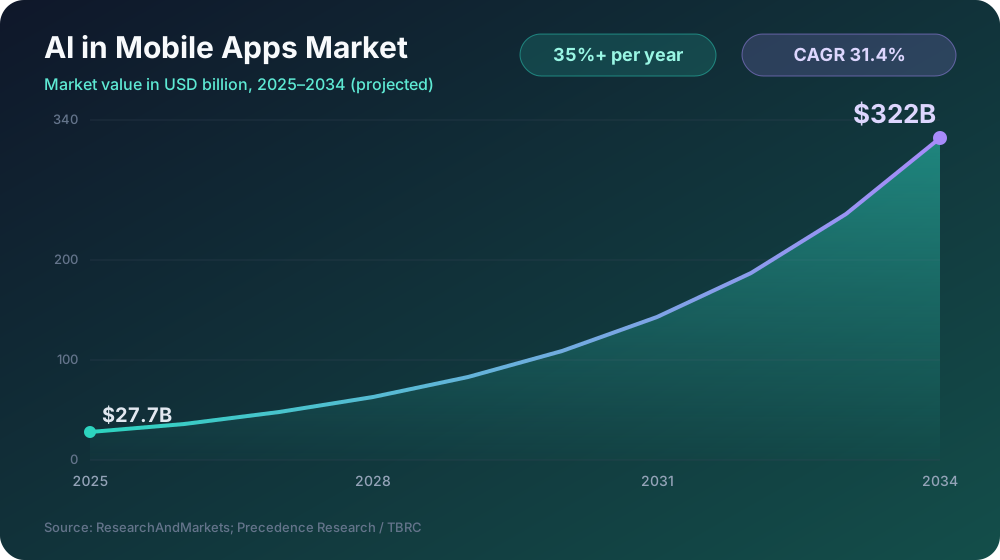
AI agent implementation has recently started gaining traction. Google and Apple have introduced built-in AI capabilities in their platforms — Gemini Nano on Google devices and Apple Foundation Models (on-device) on Apple’s recent hardware. Separately from the AI-in-fintech market cited above, the global AI mobile app market is growing at more than 35% annually, projected to exceed $135 billion by the early 2030s (Precedence Research / TBRC). Market reports highlight that advances in on-device processing are a primary driver of this growth — enabling immediate results, stronger privacy, and reduced cloud-AI costs. The broader AI-in-mobile-apps segment is forecast to reach $322 billion by 2034 at a CAGR of 31.4% (ResearchAndMarkets).
Proactive data prefetching is equally important: loading likely-needed account data on-device before the user asks reduces latency and API costs. Fintech companies must also define standards for third-party agent access — including scoped permissions, usage conditions, and audit requirements.
A Reference Architecture for AI-Driven Fintech
At a system level, a safe AI fintech app separates concerns into clear layers: a conversational and structured experience layer; an AI and agent layer for on-device models, orchestration, and prefetching; a trust and control layer that brokers scoped permissions and keeps a human in the loop; and the core banking systems underneath — all wrapped in continuous audit and compliance.
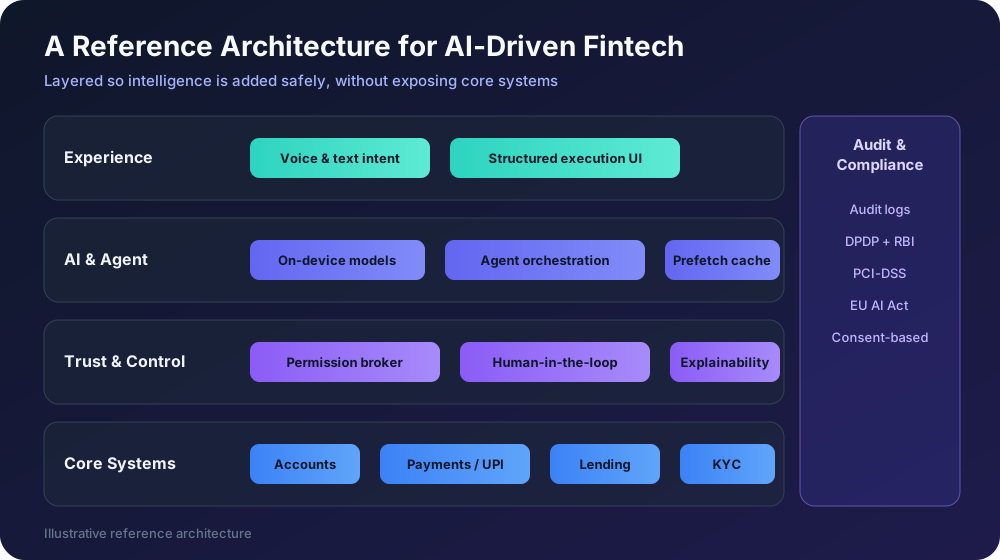
This separation lets teams add intelligence incrementally without exposing core systems, and it makes every AI-initiated action explainable and reversible. It is also what turns “add AI” from a risky rewrite into a controlled, auditable rollout.
The Business Case: What a Redesign Delivers
Redesigning around intent is not a design nicety — it is a P&L lever. Fewer steps in a flow directly lift completion and retention, while on-device inference cuts the cloud-AI cost of every request.
- Higher conversion and retention — removing steps from high-traffic flows reduces drop-off. Remember that 71% of AI-app abandonment is a UX failure, not a model failure, so design is where the returns are.
- Lower operating cost — on-device processing and proactive prefetching reduce cloud-AI spend and API calls at scale.
- Stronger engagement — proactive insights keep users returning where static dashboards cannot (Monzo’s Trends reaches 70% of customers).
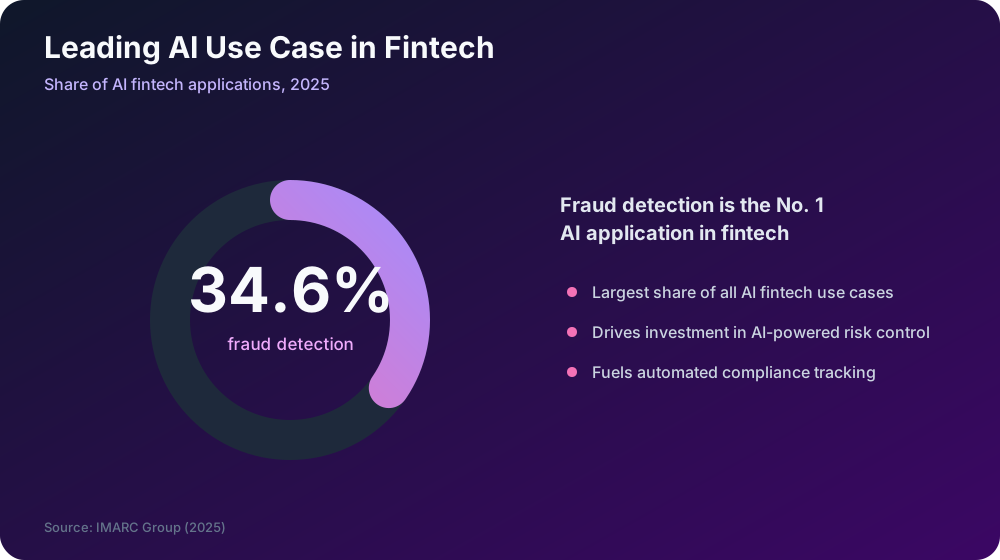
- Reduced risk exposure — explainable, auditable, consent-based flows lower compliance and fraud costs in a market where fraud detection already accounts for 34.6% of AI fintech applications.
- The cost of inaction — as UPI’s 83% share shows, users migrate fast; incumbents that delay lose the primary customer relationship, not just a feature.
A Phased Adoption Roadmap
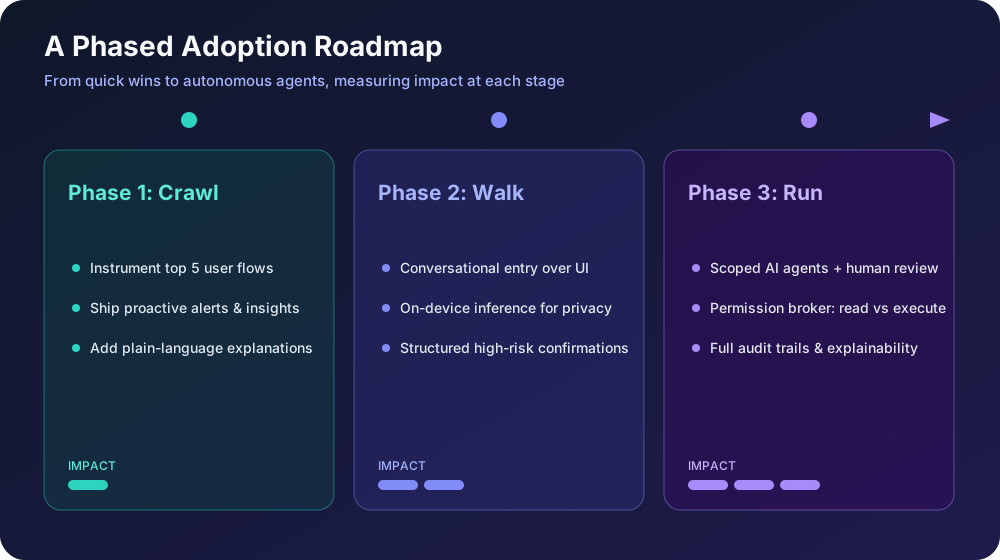
You do not need a big-bang rewrite. Adopt in three phases and measure impact at each stage before expanding scope.
Phase 1 — Crawl
Instrument your top five user flows for step count, drop-off, and time-to-task. Ship proactive alerts and spending insights, and add plain-language explanations to the decisions users already see. Low risk, fast signal, and immediate engagement gains.
Phase 2 — Walk
Layer conversational entry (text and voice) over the current UI, move sensitive inference on-device, and add structured confirmation for high-risk actions. You gain speed and privacy without rebuilding core banking.
Phase 3 — Run
Introduce scoped AI agents with a human in the loop, a permission broker that separates read from execute, and full audit trails with explainable decisions — the architecture above, fully realized.
Regulation and Failure Modes
Regulation. AI-driven financial decisions fall under increasing scrutiny. India’s Digital Personal Data Protection Act, RBI’s digital lending guidelines, PCI-DSS for payment data, and the EU AI Act for high-risk financial systems all require that AI actions be explainable, auditable, and consent-based. Product design must account for compliance from the start — not as an afterthought.
Failure modes. When AI shows a wrong balance, misclassifies a transaction, or suggests an incorrect action, users need an immediate fallback: a clear error state, a path to human support, and a manual override. Designing for AI failure is as important as designing for AI success.
Security Concerns
If agents access financial data, fintech apps must enforce:
- Least-privilege access — agents read only what they need for a given task.
- Human-in-the-loop for high-value transactions and irreversible actions.
- Scoped agent permissions — read-only vs. execute, with user-visible consent.
- On-device processing for sensitive inference to reduce data exposure.
- Audit logs for every AI-initiated action, with explainable decision trails.
Hackers also use AI to mimic user behavior patterns, making fraud harder to detect. According to IMARC Group, fraud detection accounts for 34.6% of AI fintech applications in 2025 — driving heavy investment in AI-powered risk control and automated compliance tracking. Security UX matters too: real-time fraud alerts, explainable flags, and user confirmation before blocking a transaction.
Conclusion
Significant change in fintech mobile design is already underway. It is highly challenging from both a product-design and user-flow perspective, and managing AI-driven decision-making adds another layer of complexity. Organizations that redesign around intent, transparency, and security — not just bolt AI onto existing flows — will lead the next wave of fintech.
For executives and digital leaders: treat AI adoption as a phased portfolio decision, not a single project. Pick one high-traffic flow, set explicit targets for step count and drop-off, and fund a 90-day redesign against it. Prove the ROI on that flow, then scale the pattern using the roadmap above.
For product teams and UX designers: before adding another AI feature, audit your top five user flows for step count, drop-off rate, and time-to-task. The banks and fintechs that win will not have the smartest models — they will have the fewest unnecessary steps.
References
- Fortune Business Insights — AI in Fintech market: $36.96B (2025) → $241.67B (2034), CAGR 23.20%. https://www.fortunebusinessinsights.com/artificial-intelligence-ai-in-fintech-market-106006
- Business Standard / RBI — UPI ~83% of India’s retail digital payment volume, FY25. https://www.business-standard.com/finance/news/upi-s-contribution-to-payments-ecosystem-volume-grows-to-83-4-in-fy25-125052900871_1.html
- YUJ Designs (2026) — 71% AI drop-off from UX failures; 3.2× engagement when decisions are visible; 58% distrust without explanations. https://www.blogarama.com/business-blogs/1438410-about-award-winning-design-studio-yuj-designs-blog/76240332-trends-are-changing-products-think-2026
- ResearchAndMarkets — AI in mobile apps: $27.7B (2025) → $322B (2034), CAGR 31.4%. https://www.researchandmarkets.com/reports/6164702/artificial-intelligence-ai-in-mobile-apps
- Precedence Research / TBRC — AI mobile app market growing at 35%+ annually, projected to exceed $135B by the early 2030s. https://www.precedenceresearch.com/ai-app-market
- IMARC Group — Fraud detection = 34.6% of AI fintech applications (2025). https://www.imarcgroup.com/ai-in-fintech-market
- Monzo — Spending insights (Trends) used by 70% of customers. https://www.nimbleappgenie.com/blogs/how-revolut-monzo-chime-use-ai-personalization/